Lead-Artikel
The Texture of Time
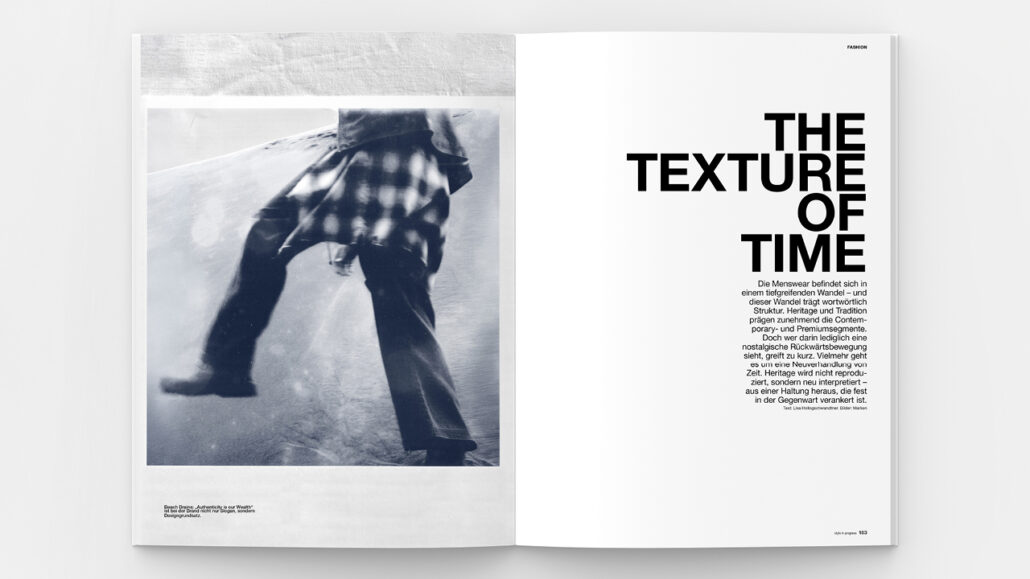
Men's fashion is undergoing a profound transformation—and this transformation is, quite literally, structural.
Heritage and tradition are increasingly shaping the contemporary and premium segments. But anyone who sees this merely as a nostalgic step backward is missing the point. Rather, it is about a reinterpretation of time. Heritage is not reproduced, but reinterpreted—from a perspective firmly rooted in the present.
A young audience member raises his hand. Trend researcher Edwin Van den Hoek has just given a talk on how strongly past decades shape the present in fashion. His statement is concise yet essential:“But your past is not our past.”This single sentence opens a discourse that seems indispensable when considering the upcoming fashion season. For while menswear for Spring/Summer 2027 draws inspiration from history, it does not replicate it. Fashion is context-dependent; accordingly, it interprets the past differently today and translates what already existed into a modern framework. This is evident not only visually but also tactilely, particularly in the materials: sturdy denim, tweed, and wool in summery blends, and leather as proof that the right products don’t lose their value over time—they gain it.
For the new season, tradition isn’t preserved in the archives but is brought to life as a working tool. Lorenzo Boglione, CEO of the BasicNet Group, describes this approach with an image that clearly sums up how modern brands operate: “We work almost like archaeologists or treasure hunters. Many of our brands have a long, multifaceted history. Our task is to identify what is relevant to the present and interpret it in a contemporary way.” BasicNet, whose portfolio includes Woolrich, Sebago, Superga, and Sundek, among others, views the archive as a starting point for the future. The same applies to WP Lavori in Corso, a distributor and licensor for brands such as Barbour, Baracuta, and Filson. Owner Cristina Calori emphasizes the current transformation and explains: “For us, heritage means studying a brand’s origins to find the right path forward. The past isn’t replicated—it must be brought into the present.”
The Return of Sophistication
After years of dominance by loud, in-your-face logos and a frenzy fueled by fast-moving trends, a profound sense of structural fatigue has set in. The appeal of mere brand names and superficial symbols is visibly fading. What remains is a desire for something that endures—both literally and figuratively; a longing for authenticity in an increasingly digitized world that often feels too polished. This development cannot be viewed in isolation. It reflects broader societal parallels: In 2025, U.S. vinyl record sales surpassed the billion-dollar mark for the first time since 1983, and experts forecast annual growth of 9.41 percent for analog photography through 2033. In menswear, this growing desire for authenticity manifests itself in the quality of craftsmanship and fabrics that can be experienced through touch.
But why are heritage, Americana references, and elements borrowed from the British countryside aesthetic meeting a need right now? One possible explanation is to view this trend as a form of escapism. The appeal of these worlds is immediately apparent. The countryside exists beyond the hyperactivity of urban life. It is a place of freedom, but also of depth, longevity, and substance. Clothing originally created for these landscapes and their challenges shares these qualities. Tweed, flannel, and waxed cotton promise durability rather than acceleration, and depth rather than mere speed.
This shift—away from a simplistic message toward inner conviction—can be observed on a collective level. Cristina Calori sums it up: “At its core, quality is a form of honesty. It’s about knowing who you are and what you want to say. The clothing we carry is aimed at people who already have answers to these questions.”
New Tactility
So the new season is all about a style of fashion where the hand reaches out before the mind makes a rational decision. Daniel Gosling, founder and creative director of Auckland-based Beach Brains, has been designing according to this credo since the brand’s inception: “For me, every design starts with the fabric. We find an exceptional quality and then ask ourselves: What are we going to do with it?” He explains his decision to consistently keep tweed in the collection across multiple seasons—even before the mainstream market followed suit—as a matter of personal conviction: “I knew this was something I’d want to wear myself.” Born out of a deliberate departure from loud, graphically overloaded, and heavily seasonally driven trends, Gosling’s brand sees itself as an alternative. Logos take a back seat, while the focus shifts to construction—with a clear commitment to longevity. The phrase “Authenticity is our Wealth,” found on the website, is less of a slogan and more of a philosophy.
For Jesper Møller Christiansen, brand manager of the Danish brand Anerkjendt, authenticity, honesty, and a return to the genuine are not merely a marketing ploy, but a matter of substance. Scandinavian workwear, for example, serves as the brand’s creative foundation. For Christiansen, the art lies in the translation: “We take details—whether fabrics or specific elements—and place them in a new context to make them contemporary.” When, for example, a classic military fatigue pocket is suddenly placed on a pair of modern ripstop pants, it creates precisely this balance between yesterday and today. However, Christiansen warns against mere superficiality when brands simply jump on the trend bandwagon. According to him, true authenticity is demonstrated above all by whether a brand has truly understood the stories behind these references and can tell them credibly.
Age of Algorithms
Another driver behind the current enthusiasm for haptics is the rapid advancement of digitalization and AI. For while technological capabilities streamline design and production processes, they also create a new form of longing. The more perfectly algorithms produce, the more valuable the human element—the deliberate imperfection—becomes. Visible craftsmanship—such as a seam or a fabric that ages and changes over time—thus becomes a new hallmark of quality in menswear.
In this context, in addition to looking at classic American or British brands, it’s also worth noting Asian design schools. Japanese and Korean labels, in particular, have consistently further developed this return to artisanal attention to detail and complex constructions. Marc Weinreuter, a watch and fashion editor and an expert on the world of heritage, has been observing this trend for decades. He points to the pivotal role played by Japanese manufacturers: “They have consistently carried on the American textile heritage—often with a level of care that surpasses the original.” As early as the 1980s, many of them began searching for original military pieces in the U.S. and acquiring historic shuttle looms. Many of these machines are still found in Japanese workshops today and are used to further develop traditional techniques and adapt them to new contexts. This is how products with lasting value are created.
Speaking of longevity: For Lorenzo Boglione, quality and durability are the industry’s only honest response to the sustainability debate. “The only truly sustainable solution is to buy things that last forever,” says the CEO, citing Woolrich jackets from family archives that are still in pristine condition after decades. The product thus becomes proof of its own durability. Cristina Calori adds: “At a time when technology can produce almost anything quickly and inexpensively, a product’s craftsmanship becomes the last genuine distinguishing feature.” The details on a Filson tin-cloth jacket, the edged buttonholes on a waxed Barbour jacket, the rolled collar of a Baracuta G9—these aren’t merely decorative choices. They are functional choices that also reveal a great deal about the thoughtfulness behind the garment. In today’s menswear, construction speaks to character. It reveals how a brand thinks about the long term—whether it’s designing for this season or for the years to come.”
Times of Trust
When logos lose their appeal and names alone no longer provide legitimacy, a concept that often exists only as a buzzword comes to the forefront—a concept that regains its full meaning here: trust. Trust is the true currency in a market that longs for a slower pace.
In the retail world, this new era of reliability calls for a consistent approach. Thomas Jablonski runs the Düsseldorf boutique Stuf|f—which he founded together with Stephan Bartelmuss—under the motto “Stephan, Thomas, and Friends—The Finest.” His “self-indulgent lifestyle concept” is based on selling only what he and his team love themselves. The result is a curated selection full of “soul-made” brands. For Jablonski, honesty matters more than quick sales. His customers aren’t heritage stereotypes, but men who long for things that last: “I think the beauty of the kind of fashion we sell is its durability. Our customers appreciate the peace of mind that comes from knowing: whatever they buy from us, they can wear for a very long time.”
Firuse Attar, owner of the Vienna boutique Firis, has also turned her back on large, impersonal designers. Instead, she focuses on brands that put their heart and soul into their work, and she’s particularly fond of Italian and Japanese labels where the craftsmanship is still palpable. In doing so, she caters to the tastes of her customers, whose shopping habits have clearly changed: “Men today are more fashion-conscious and better informed than ever before. They keep a close eye on the market, have become more body-conscious, and often know exactly what they want the moment they walk into my store.” For the boutique owner, this informed customer is not an obstacle, but rather a confirmation of her philosophy—moving away from big names toward an appreciation of what is genuine and tangible.
Brands themselves are also looking for an environment like this. Daniel Gosling has a clear business strategy: He doesn’t want to run a “faceless corporation,” but rather to be present in the right stores with the right people, so that customers retain the feeling of having discovered something special. Jesper Møller Christiansen shares a similar perspective and emphasizes that shared growth is based on mutual understanding and a genuine interest in each other’s DNA.
Building the Present
Knowing where you come from. Knowing where you want to go. Today’s menswear is by no means stuck in a nostalgic loop, but rather undergoing a powerful process of refinement. At its core is a return to what endures: construction, attitude, and honesty.
The thesis mentioned at the beginning—"Your Past is not our Past"—put forward by Van den Hoek’s young listener is not a rejection of history, but rather an invitation to reinterpret it: without sentimentality, but with an awareness of one’s own target audience, its expectations, experiences, and context.
The fabric that catches your eye. The seam that remains visible. The story that needs no explanation because it conveys a universal truth about quality. Products that offer this provide stability in uncertain times. Heritage, then, is not merely a reference. It is a method; it is the way we build the present and shape the future.