Essay
The New Currency of Meaning
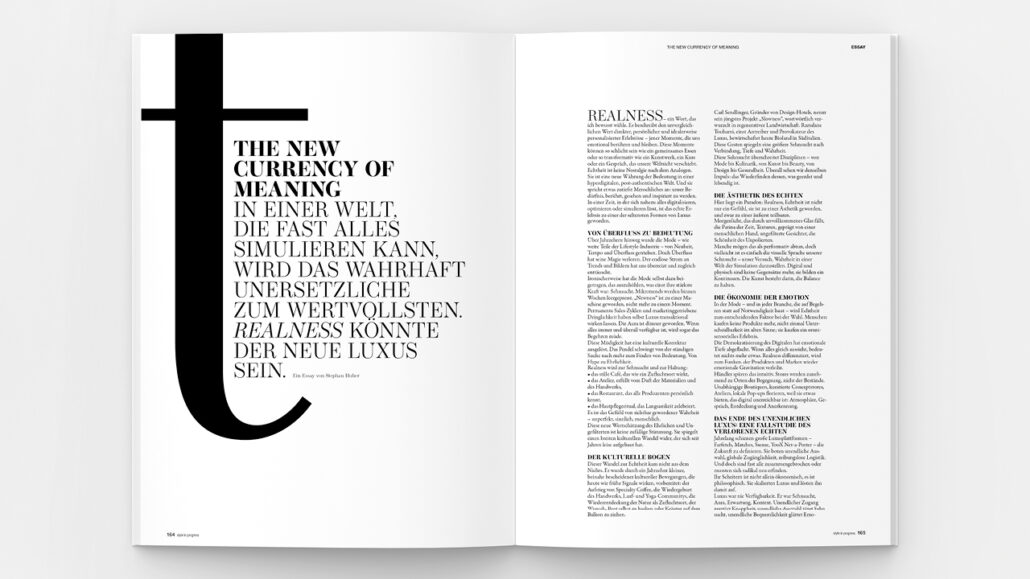
In a world that can simulate almost anything, what is truly irreplaceable becomes the most valuable. REALNESS could be the new luxury.
An essay by Stephan Huber
Realness—a word I choose deliberately. It describes the incomparable value of direct, personal, and ideally personalized experiences—those moments that touch us emotionally and stay with us. These moments can be as simple as sharing a meal or as transformative as a work of art, a kiss, or a conversation that shifts our worldview.
Authenticity is not nostalgia for the analog. It is a new currency of meaning in a hyperdigital, post-authentic world. And it appeals to something deeply human: our need to be touched, seen, and inspired. In an age when almost everything can be digitized, optimized, or simulated, the genuine experience has become one of the rarest forms of luxury.
From abundance to meaning
For decades, fashion—like much of the lifestyle industry—was driven by novelty, speed, and excess. But excess has lost its magic. The endless stream of trends and images has overstimulated and disappointed us at the same time.
Ironically, fashion itself has contributed to undermining what was once its strongest force: longing. Microtrends are squeezed dry within weeks. "Newness" has become a machine, no longer a moment. Permanent sales cycles and marketing-driven urgency have made even luxury seem transactional. The aura has become thinner. When everything is available anytime, anywhere, even desire becomes weary.
This fatigue has triggered a cultural correction. The pendulum is swinging from the constant search for more to the search for meaning. From hype to honesty.
Realness becomes a longing and an attitude:
• the quiet café that feels like a refuge,
• the studio, filled with the scent of materials and craftsmanship,
• the restaurant that knows all its producers personally,
• the skincare ritual that celebrates slowness.
It is the feeling of truth becoming visible—imperfect, sensual, human. This new appreciation for honesty and authenticity is not a random mood. It reflects a broad cultural shift that has been quietly building for years.
The cultural arc
This shift toward authenticity did not come out of nowhere. It was preceded by a decade of small, almost modest cultural movements that now seem like early signs: the rise of specialty coffee, the rebirth of craftsmanship, running and yoga communities, the rediscovery of nature as a refuge, the desire to bake bread yourself or grow herbs on your balcony.
Carl Sendlinger, founder of Design Hotels, calls his latest project "Slowness," literally rooted in regenerative agriculture. Ramdane Touhami, once a driving force and provocateur of luxury, now farms organic land in southern Italy. These gestures reflect a greater longing for connection, depth, and truth.
This longing transcends disciplines—from fashion to cuisine, from art to beauty, from design to health. Everywhere we see the same impulse: rediscovering what is grounded and alive.
The aesthetics of authenticity
Here lies a paradox: realness, authenticity is not just a feeling, it has become an aesthetic, and an extremely shareable one at that.
Morning light shining through imperfect glass, the patina of time, textures shaped by human hands, unfiltered faces, the beauty of the unpolished.
Some may dismiss this as performative, but perhaps it is simply the visual language of our longing—our attempt to represent truth in a
world of simulation. Digital and physical are no longer opposites; they form a continuum. The art lies in maintaining balance.
The economics of emotion
In fashion—and in any industry that relies on desire rather than necessity—authenticity becomes the deciding factor in purchasing decisions. People no longer buy products, or even distinctiveness in the old sense; they buy an omni-sensory experience.
The democratization of digital technology has flattened emotional depth. When everything looks the same, nothing means anything anymore. Realness differentiates, becoming the spark that restores emotional gravity to products and brands.
Retailers intuitively sense this. Stores are increasingly becoming places of encounter rather than inventory. Independent boutiques, curated concept stores, studios, and local pop-ups are flourishing because they offer something that cannot be achieved digitally: atmosphere, conversation, discovery, and recognition.
The end of infinite luxury: a case study of lost authenticity
For years, large luxury platforms—Farfetch, Matches, Ssense, YooX Net-a-Porter—seemed to define the future. They offered endless choice, global accessibility, and seamless logistics. And yet, almost all of them have collapsed or had to radically reinvent themselves.
Their failure is not only economic, it is philosophical. They scaled luxury and thereby dissolved it.
Luxury was never about availability. It was about longing, aura, expectation, context. Unlimited access destroys scarcity, unlimited choice kills longing, unlimited convenience dulls emotions. These platforms optimized efficiency but forgot the magic.
Their large-scale cultural curation failed due to structural limitations. All that remained was meaninglessness.
The deeper failure was a breakdown in relationships. Luxury is a human economy: an economy of emotion, conversation, intuition, and above all, trust. Independent retailers have always understood this. Their value lies not only in what they sell, but how they do it—with atmosphere, honesty, presence, personality. A platform can deliver speed, but not soul.
The fall of the online luxury giants is a cultural signal. People are turning away from endless abundance and returning to meaningful experiences. They did not fail because of competition, but because of the human desire for authenticity.
The rebirth of luxury and the new relevance of retail
Authenticity could be what leads luxury out of its identity crisis. Traditional markers—exclusivity, price, digital glamour—are losing relevance in an era of algorithmic uniformity. The new luxury is not about owning more, but feeling more.
When meaning returns to the center of culture, a rare opportunity arises for the fashion trade, not only for luxury, but for the entire landscape of independent multi-brand stores, concept shops, and small creative retailers in Europe.
At first glance, optimism about brick-and-mortar retail may seem almost naive, but it is not. Reimagined as hospitality, as a cultural space, as a place of presence and connection, its future is not threatened, but promising.
For years, brick-and-mortar retail has been accompanied by a narrative of decline: falling footfall, rising rents, the dominance of e-commerce. But what if the paradigm is shifting? What if physical retail is not a relic, but one of the most important anchors of fashion?
If our theory is correct—and all signs point to it being so—real-world retail will become more meaningful, not less. This is especially true for younger generations. Numerous international studies, including KPMG, show a clear pattern: Gen Z is not turning away from stores, it is returning to them. They see retail as a cultural space, a place of discovery, connection, and experience. The more digital their lives become, the stronger their longing for what only the physical world can offer.
Stores can become places where emotion is created, not consumed; where discovery is curated, not predicted; where atmosphere, texture, scent, and conversation matter again; where clothing becomes culture, not content.
None of this is new. It is the rediscovery of the original essence of trade: relationship, not transaction. A genuine form of hospitality in the true sense of the word.
The key point is that it's not about luxury defined by price. It's about luxury defined by connection, care, presence, and relevance. A small independent store can appear more "luxurious" than a global flagship if its selection shows attitude and its conversations show sincerity.
The opportunity lies in regaining what cannot be replicated digitally:
• Atmosphere – the sensory world of a store.
• Perspective – the intuition and taste of a shopper.
• Curation – not more, but better.
• Community – the feeling of being welcome, seen, understood.
• Discovery – those unexpected encounters that algorithms cannot predict.
• Continuity – relationships with people, not interfaces.
This moment invites retailers to reclaim their cultural role—as hosts, editors, translators. They offer not only products, but depth; stores are places where fashion is experienced as something alive, something real. The future of retail will not belong to the biggest. It will belong to the most human. This change is not only about survival, but also about a new relevance.
The value of the irreplaceable
This is not just a trend. We are experiencing a cultural shift that goes far beyond fashion. In gastronomy—and in many ways, that's where it started—we saw a return to simplicity, regionality, origin, and emotional storytelling. Hospitality and travel followed the same arc: away from ostentation, toward rootedness, intimacy, and humanity. We are seeing the rise of clear beauty and longevity—movements that respond to the urge for perfection with honesty, ritual, and care.
The change is also evident in art: away from spectacle, toward materiality, process, community, resonance. The works that remain are not the loudest, but those that touch the viewer.
Realness has become a common language across disciplines—a way to reconnect creativity with humanity.
At its core, however, it is about the value of the irreplaceable.
Value is not created by supply chains or marketing cycles, but by the depth and uniqueness of an experience.
As entrepreneurs, creatives, and decision-makers, we shape how realness takes form—in the spaces we design, the products we create, and the stories we tell. Because in a world that can simulate almost anything, what is truly irreplaceable becomes truly valuable. And today, more than ever, that is the essence of luxury.


