Herman Konings X Susanne Tide Frater
The Rise of Authenticity
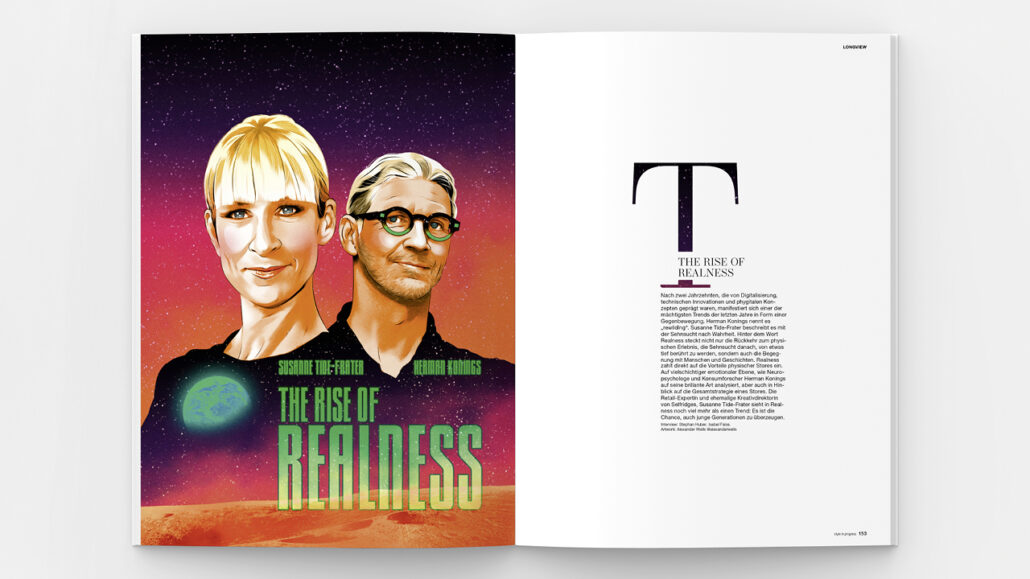
After two decades marked by digitalization, technical innovations, and phygital concepts, one of the most powerful trends of recent years is manifesting itself in the form of a counter-movement. Herman Konings calls it "rewilding." Susanne Tide-Frater describes it as a longing for truth. The word "realness" encompasses not only a return to physical experiences and a longing to be deeply moved by something, but also encounters with people and stories. Realness directly contributes to the advantages of physical stores. On a multi-layered emotional level, as neuropsychologist and consumer researcher Herman Konings brilliantly analyzes, but also in terms of a store's overall strategy. Retail expert and former creative director of Selfridges, Susanne Tide-Frater, sees realness as much more than a trend: it is an opportunity to win over younger generations.
Interview: Stephan Huber, Isabel Faiss. Artwork: Alexander Wells @alexanderwells
Especially in an environment where it is increasingly about what customers really want and desire, rather than what they need, realness is becoming a central requirement—one that concerns us all, particularly in relation to business models and consumption. Broken down to the authenticity of an experience, we have even made the term the central theme of this issue. Its meaning is multifaceted. What do you associate with this buzzword?
Herman Konings, consumer researcher, retail psychologist, and managing director of Pocket Marketing: For me, realness means experiencing something unfiltered with all five senses—real sensations without the interference of numbers, bits, and bytes. It's more than just a physiological phenomenon; we call it the sixth sense. It's the complete experience, greater than the sum of its parts. As a trained neuropsychologist, I can tell you that when your five senses are working unfiltered, it feels like a highway to the limbic system – the emotional core of the brain – where neurotransmitters and happiness hormones such as serotonin, endorphins, dopamine, and oxytocin are released. The limbic system also stimulates creativity, productivity, and even the immune system. With Gen Z in particular, we see a strong desire for personal, physical interaction within their communities. They actually prefer physical experiences such as brick-and-mortar stores more than millennials.
Susanne, even before you became Creative Director at Selfridges, you were deeply involved with the topic of realness in retail. What does this term mean to you?
Susanne Tide-Frater, retail strategist and former creative director at Selfridges: One of my strengths is observing and interpreting consumer behavior. I define realness as the epitome of what is authentic, tangible, and present—be it a product, an experience, a way of thinking, or a person's mindset. It is the opposite of fantasy, dreams, constantly changing trends, and the cult of the new, which has traditionally been the definition of luxury. Why is realness particularly important for younger generations such as Gen Z, Alpha, and Beta? Because it has become rare, and scarcity is known to create desirability. We live in a world dominated by fake news, fickle politics, and personalities constructed for public consumption. Globalization has failed, and overconsumption brings with it ecological and ethical problems. Celebrities, as testimonials, have all too often desecrated the cathedral of luxury, so to speak. The younger generations, the digital natives, are disillusioned and feel confronted with a great social responsibility. They live in different economic and personal circumstances and are looking for genuine exchange. Realness could be a new definition of luxury, one that allows for brands, craftsmanship, products, spontaneity, interaction, and deviations from the script. The basis for this is the pursuit of truth and emotions.
Has the need of Gen Z and younger generations to be touched in the truest sense of the word triggered this trend?
Herman Konings: Absolutely . Due to COVID-19, this generation was essentially denied social interaction during one of the most crucial phases of their lives. The enforced isolation provoked an irrepressible need for a healthy social life. Gen Z was also largely denied the opportunity to help shape their own youth culture through their behavior. Over the past two years, surveys across Europe have shown that Gen Z employees (aged 16 to 30) overwhelmingly prefer going to the office when asked whether they would rather work from home or go to the office. This confirms once again the desire for realness, even in everyday working life. We call Gen Z "the most generation" because they have the absolute maximum of everything: they are the most adept at using digital media, the most globally connected, the best educated, and the most inclusive. They are the first adult generation to have grown up entirely in a digital environment. The desire for realness is very clearly linked to the issue of scarcity here.
Susanne Tide-Frater: I have a slightly different perspective. We must ensure that our own situation does not influence our judgment. Realness is not a competition between digital and analog. Technology is not a decisive factor here. Gen Z feels much more socially responsible and is disillusioned by our society's excessive consumption, but it is not anti-technology. It simply uses technology differently: to find like-minded people, participate in social commerce, exchange ideas, or take part in immersive and interactive events, rather than simply buying and consuming information.
If realness is the new luxury, what role do interpersonal relationships and personality play?
Susanne Tide-Frater: A very important role—but the type of personality we are talking about is different. It's not about testimonials. Young customers in particular are enthusiastic about real, intense experiences and personalities. Communities and individuals shape their positive experiences. I'm currently seeing a good example of this here in the south of France: more and more young, local, new brands are emerging, such as Natif, which is deeply rooted in French surfing culture and has good vibes in its DNA. They sell fashion, but they also brew their own beer and organize a summer music festival. Their local identity gives them global resonance. This example shows once again that if you want to sell a product or experience to Gen Z, you have to be part of a credible community and not a globally active, paid influencer.
When we talk about making consumption meaningful again, I am reminded of a quote by Claus Sendlinger that I find very apt: "In the future, there will be no retail without hospitality." I am still convinced that consumption is at the heart of our society and even the engine of civilization. However, if consumption increasingly shifts from need to the search for emotional experiences, retailers will have more tasks than just selling products.
Susanne Tide-Frater: Hospitality fascinates me. Many people still think it means offering food or drinks to keep customers in the store longer. But it's about much more than that. It's about how a customer is welcomed, accompanied through an experience, and looked after with personal service. I firmly believe in the principle of the store for one—a store where the customer feels as if it were made just for them. This all contributes to this attitude toward the customer. For me, hospitality is the key to all successful concepts of the future.
Herman Konings: And it also contributes to the famous four Es of retail: ethereal, enriching, emotional, and exclusive. Hospitality is also about empathy!
In recent years, we have seen major online retailers such as Matches, SSENSE, and Farfetch fail. Is the business model based on a misinterpretation of human nature, or to put it another way: was it lacking in authenticity?
Susanne Tide-Frater: More than that. Remember: Farfetch started out as an online platform for owner-operated boutiques with the aim of saving independent retailers. But its rapid success turned it into an omnivore, and the original vision was lost—a widespread problem. Economic pressure and the goal of rapid growth often make them forget that their business model is based on real customers. Retailers who have continued to add more brands to their range have simultaneously lost sight of the curatorial aspect of their profession. Realness therefore also represents a great opportunity for independent retailers in this area. They can create authentic experiences on a smaller scale and grow sustainably with their customers. That is the key to success.
We humans have undergone an almost endless evolution in which realness has played a decisive role, if only through the connection between tactile experiences and our brains. Sometimes I feel that digitalization wants to catch up with this evolution in just one or two generations. Can that work? Can learned social and tactile behavior patterns really be completely overcome? Or to put it another way: Are we humans even made for a digitalized world?
Herman Konings: Definitely not. Psychologists and sociologists have long been advocating for us to "renaturalize" or "rewild" our brains. Constant exposure to bits and bytes is damaging our brains and our emotional well-being. Neurotransmitters such as serotonin, dopamine, endorphins, and oxytocin, which are essential for our sense of happiness, are lost in the digital world. We are becoming zombies. Research shows a clear counter-movement to the digitization of social life. I have some figures from Euromonitor, one of the leading research platforms. Every year, they survey 20,000 people in Western Europe about their attitudes toward AI in two scenarios. One involves a bot that helps with shopping, and the other involves autonomous driving. The question is always: How comfortable are you with AI at your side? Among baby boomers (61+), 30 percent say they feel very comfortable. Among Generation X (46 to 60), 40 percent agree. Millennials (31 to 45) feel even more comfortable, at 52 percent. Interestingly, Generation Z (16 to 30) falls back to 40 percent, which is the same level as their parents. The closer you get to the generation that grew up most with digitalization, the less comfortable they feel with AI applications. They even prefer physical stores to online shopping. Psychologically, this is understandable: young people are exhausted by digital sensory overload – not only neurologically, but also in a broader cognitive and emotional sense.
What does this mean for the future of retail?
Herman Konings: Much revolves around hospitality as the most human business of all. I mentioned our social renaturalization earlier, and the same must happen in retail. It's about bringing retail back to human interaction and the experience of the four Es. Even outside the luxury segment, a store must offer its customers a comprehensive enrichment without overstimulating or oversaturating them. American psychologist Prof. Dr. Dacher Keltner has written a book entitled "Awe." Awe is an old English word that describes a state of being completely overwhelmed emotionally. A store must convey this everyday awe to its customers, defined by these nine wonders: moral beauty, nature, collective enthusiasm, visual art or design, music, spirituality, humor, big ideas, and—my personal favorite—epiphanies. Epiphanies are random experiences with a surprising wow factor. They are thus the opposite of algorithms. An algorithm gives me the straight path from A to B. A store must be the exact opposite of that: like searching for a needle in a haystack, where you unexpectedly come across the pretty farmer's daughter and fall head over heels in love.
Susanne Tide-Frater: In my opinion, innovation is still crucial, and I don't want to distinguish between brick-and-mortar and digital retail. These are two aspects that should merge seamlessly. Innovation and technology are valuable tools. But AI and technology will never replace human relationships or personal service; they can only make many things easier. What technology cannot offer is the emotional fulfillment of a real experience: realness. That will remain the domain of brick-and-mortar retail. There are still many exciting things ahead of us. Let me conclude with an experience I recently had on the subject of realness: I visited the Fondation Carmignac on the island of Porquerolles. You take a boat, arrive on the island, and visit the art exhibition in the main building. You take off your shoes and it is completely silent. You can feel the ground beneath your feet. After the exhibition, you can view sculptures in the adjoining park and go to the small restaurant, where the chef prepares only four dishes. You sit under the trees, regardless of whether it is raining or the sun is shining. You enjoy wonderful food full of local flavors and spend hours there. This experience is unique. And the icing on the cake? The store! It is completely woven into the overall concept of the place. For me, the visit was an incredible, transformative experience that confirmed to me that the things we strive for are more important than the things we only need.
Susanne Tide-Frater
There is probably no one in the industry who does not immediately associate the name Susanne Tide-Frater with the very elegant, charismatic image of an influential and successful strategist. Her career reads like a textbook for applied creative industries. For this reason, here is just a brief outline: After completing her training in Paris at the Institut Français de la Mode, she started as Head of International Relations. As Creative Director of Selfridges, she then entered the industry directly and made a name for herself with experimental retail concepts.
Next came the position of Creative Director at Harrods, where she played a key role in the innovative development of the traditional company. Her keen instinct for building brands and their strategic development led her to become Fashion Director at Victoria Beckham's label, which was then a relatively small celebrity brand, and which she established as an international luxury brand.
Susanne Tide-Frater also joined Farfetch in 2010 as Brand and Strategy Director, where she dedicated herself to the seamless implementation of phygital innovations at Browns East, among others, until 2023.



Herman Konings
"I am the Shrink," is how Herman Konings describes himself with his engaging laugh. Listening to him intently is a real pleasure. The stand-up psychologist manages like no other to not only convey profound scientific data analyses and research results in an easily digestible way, but also to infect his audience with his own enthusiasm for consumer research. From Gen Beta to the baby boomers, he plays the entire keyboard of consumer research based on data. He finds his audience at international panels and as a speaker at conferences and events. His expertise is in high demand: born in 1964, he holds a master's degree in theoretical and experimental psychology with a specialization in neuropsychology and has made a name for himself internationally as a consumer and trend researcher. He is also the managing director of the Antwerp-based trend research agency Pocket Marketing.