Simone Rocha
Emotional Structures
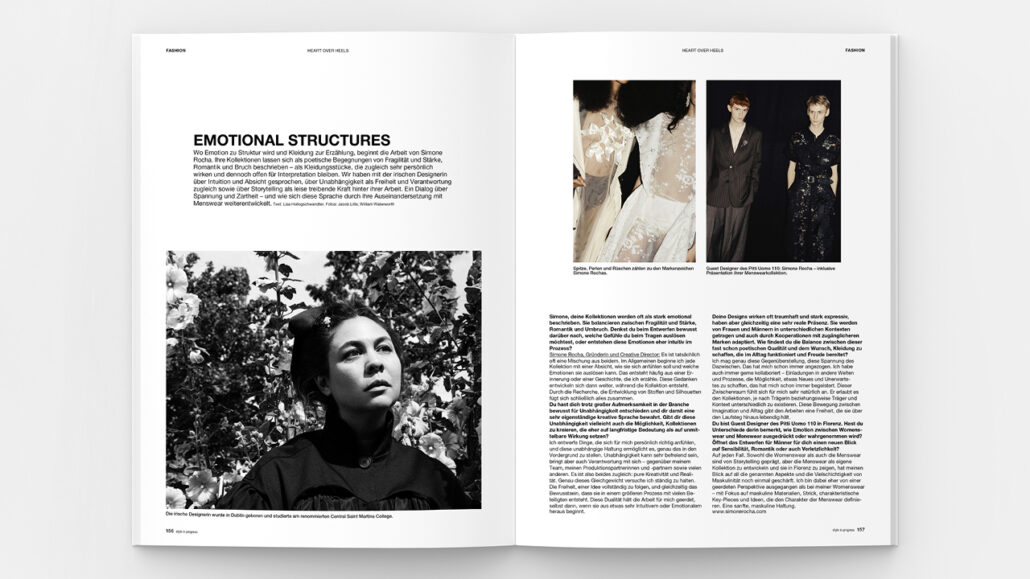
Simone Rocha’s work begins where emotion becomes structure and clothing becomes a narrative. Her collections can be described as poetic encounters between fragility and strength, romance and rupture—as garments that feel deeply personal yet remain open to interpretation. We spoke with the Irish designer about intuition and intention, about independence as both freedom and responsibility, and about storytelling as the quiet driving force behind her work. A dialogue about tension and delicacy—and how this language continues to evolve through her exploration of menswear.
Text: Lisa Hollogschwandter. Photos:JacobLillis, William Waterworth
Simone, your collections are often described as deeply emotional. They strike a balance between fragility and strength, romance and upheaval. When you’re designing, do you consciously think about the feelings you want to evoke in the wearer, or do these emotions arise more intuitively during the process?
Simone Rocha, Founder and Creative Director:It’sactually often a mix of both. Generally, I start each collection with a vision of how it should feel and what emotions it can evoke. This often stems from a memory or a story I’m telling. These ideas then continue to evolve as the collection takes shape. Through research and the development of fabrics and silhouettes, everything eventually comes together.
Despite receiving a great deal of attention in the industry, you have consciously chosen to remain independent, thereby preserving a highly distinctive creative voice. Does this independence perhaps also give you the opportunity to create collections that focus more on long-term significance than on immediate impact?
I design things that feel right to me personally, and this independent approach allows me to focus on exactly that. Independence can be very liberating, but it also comes with responsibility—toward my team, my production partners, and many others. So it’s both at the same time: pure creativity and reality. That’s exactly the balance I constantly strive to maintain. The freedom to fully pursue an idea, while at the same time being aware that it emerges from a larger process involving many people. This duality keeps my work grounded—even when it begins from something very intuitive or emotional.
Your designs often have a dreamlike and highly expressive quality, yet at the same time they have a very real presence. They’re worn by women and men in a variety of contexts and are also adapted through collaborations with more accessible brands. How do you strike a balance between this almost poetic quality and the desire to create clothing that works in everyday life and brings joy?
I really like this juxtaposition, this tension in the space in between. It’s always drawn me in. I’ve also always enjoyed collaborating—invitations into other worlds and processes, the opportunity to create something new and unexpected—that’s always inspired me. This in-between space feels very natural to me. It allows the collections to exist in different ways depending on the wearer and the context. This movement between imagination and everyday life gives the pieces a freedom that keeps them alive beyond the runway.
You are the Guest Designer for Pitti Uomo 110 in Florence. Have you noticed any differences in how emotion is expressed or perceived in womenswear versus menswear? Does designing for men offer you a new perspective on sensitivity, romance, or even vulnerability?
Absolutely. Both womenswear and menswear are shaped by storytelling, but developing menswear as a separate collection and presenting it in Florence has once again sharpened my perspective on all the aspects mentioned and the complexity of masculinity. I took a more grounded approach than I did with my womenswear—focusing on masculine materials, knitwear, signature key pieces, and ideas that define the character of menswear. A gentle, masculine attitude.


