Ramdane Touhami
“It’s too easy for me—I’ve done it all”
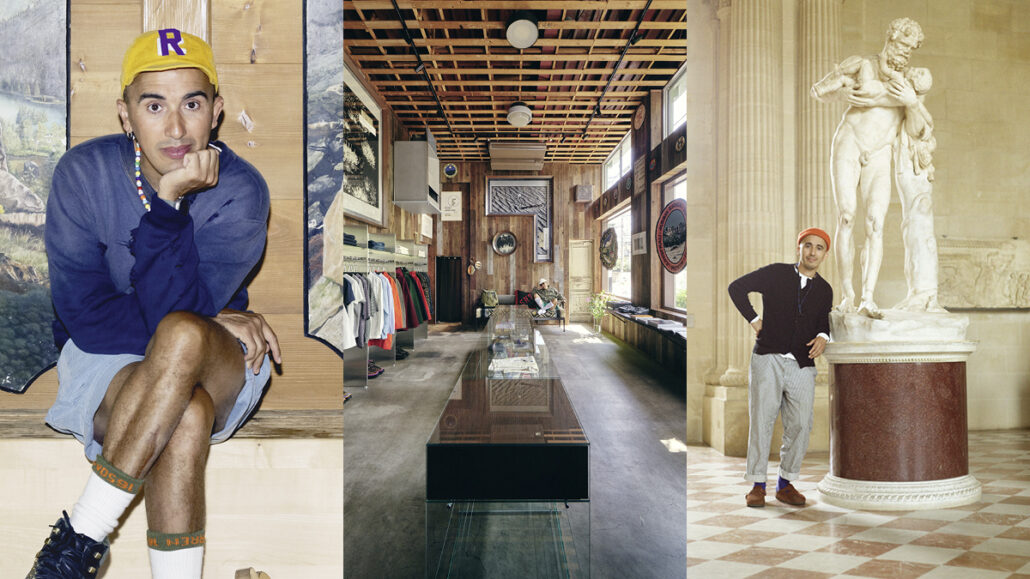
His career reads like a journey through every discipline of the creative industry, and at the same time captures Ramdane Touhami’s defining trait: he is always striving for something new, he detests the mainstream, and he never compromises.
Interview: Stephan Huber. Text: Isabel Faiss.
He has been active in the industry as an artist, creative director, and entrepreneur since the early 1990s; in 1997, he opened his first concept store, L’Épicerie, in Paris. Over the course of his career, he has been directly or indirectly involved in the creative development of some 400 stores. In 2021, he and his wife Victoire de Taillac sold their luxury perfume brand Officine Universelle Buly to the LVMH Group. One might think that Ramdane has since settled down and is taking time to pursue his passions—which he is doing, just not in the way one might expect.
Authenticity seems to be the driving force behind everything you do—as a creative, as an entrepreneur, and as a person. What does authenticity mean to you?
Ramdane Touhami: In Japanese, there’s a word: honmono. It means that something is truly authentic and, at the same time, benefits many people—not just a select few for a specific purpose. For me, authenticity means doing something because you truly believe in it, not because there’s a market for it. That’s also my personal guiding principle. I create my own product and then see where it takes me.
Doesn't that actually make "realness" the epitome of luxury?
First of all—and I hope I’m not being too provocative for this magazine—I have to be honest and say that I couldn’t care less about the concept of luxury and everything it stands for. It has lost its meaning. The only thing “luxury” describes today are fat, hefty margins. The costs for that are 15 to 20 percent. Realness has nothing to do with luxury; it’s pretty much the exact opposite of it.
But hasn’t there been a shift in how consumers perceive luxury? In the sense that they’re investing less in a handbag and more in their own well-being?
That depends on your perspective, but I don’t think things have changed dramatically. Yes, there are customers who no longer buy luxury handbags or the stories behind them. But they’re few and far between. For the majority, status symbols like these are still relevant. If you’re not rich, luxury is pure longing. Right now, I can’t quite see where this market and the consumer landscape are headed. To me, we’re currently in a period of nihilism. Nobody cares anymore—these are dark times. That worries me. Who still believes in the future these days?
I believe in the future!
And can you tell me what it means for us? I certainly can't. Things are changing so fast that I have no idea what's coming. It's terrifying!
Isn't constant change exactly what best describes your career?
Not for their own sake. For me, there’s no reason to keep flooding the market with more and more ideas and products without a clear vision. I don’t want that anymore. Fast-paced trends and seasons are product killers. Why don’t we repair and repurpose all vintage products? Or, if we’re going to create something new, why not do it without seasonal limitations? The market is completely oversaturated. Every day I get five to ten calls from new fashion or beauty brands asking me about a collaboration. Too many brands and artists are trying to elevate their product through this kind of interdisciplinary collaboration—and most of them fail. We should all take a step back. Good concepts, good products, and passionate people still have real potential.
And how can this trend be reversed?
By waiting and being patient. For example: Over the past three years, I’ve been passionately collecting vintage furniture. Now I’m ready to launch a store that showcases these carefully selected, finely curated rarities. To that end, we’re constantly gathering old and beautiful items to offer our customers a truly lasting experience. Today, one simply has to ask: Why do we all still buy so much, even though it would be better for our environment to consume less?
Is that why you think retailers are struggling so much these days?
Good stores don’t falter. Everything I do with stores grows successfully. For example, here—at Words, Sounds, Colors & Shapes in Paris—we generated two million in revenue in the first year alone without any PR campaign. Because I know how the business works. For me, it’s become too easy. I’m convinced that the only true source of success is still an exceptionally good product offering. That takes courage. I’ve always pushed boundaries and run stores my way.
Or were you especially good at storytelling?
No, enough with the storytelling! That’s not what this is about. All that matters is the product and the price. Someone has to tell a story, but a good product speaks for itself—it doesn’t need a backstory. For example, we hardly ever post on social media. We don’t have a story we want to tell. But we have exceptional products. That’s what it’s all about!
You say you've lost your enthusiasm for the retail business. Why?
It’s a tough time for retail—and that’s a good thing. Change always begins with stepping out of your comfort zone. Stupid people from business schools think they have the magic formula for retail. For example, blasting music from a DJ on the turntables at the bakery while customers are buying their Sunday rolls. That’s bullshit. Everywhere I look, I see this frantic search for innovative ideas that go viral in real time and then crash. It’s like a hysterical sugar rush. I don’t want to be part of this show. I’m interested in concepts with depth that bring together different perspectives on creativity and invite their audience to enjoy an authentic experience.
What advice would you give to someone who wants to open a store?
Good luck! I used to be the most enthusiastic entrepreneur in the world, but right now all I see around me are concepts that do more to disfigure the city than to enrich it. My advice would be: Leave your business plan at home, burn it, and let your creativity and instinct do the work. This business isn’t just about margins and marketing. What counts is authenticity. Don’t overanalyze everything—just do it! That mindset we used to have in retail is, for me, still the heart and soul of independent concepts. But somehow, it’s been lost.
You put a lot of heart and soul into the redesign of Liberty 2023, among other things. What excited you most about it?
First and foremost, I loved working with Lucille Lewin. She was Liberty’s creative director at the time. When I first visited, I thought it was one of London’s oldest department stores—because of its medieval style—but it was actually one of the newest. I loved this Umberto Eco-esque, hyper-realistic imitation of historical styles. Lewin hired me to redesign the menswear department and gave me a lot of creative freedom for the job. First, I launched 62 new brands that no other store in London carried at the time. That was a big step for Liberty, a financial risk, but they took it on.
So your advice would be: Find something that no one else is doing?
More like: Don’t create a concept that has no market! That’s what happened to us with A Young Hiker in Paris. We had to realize that there’s no customer base in Paris interested in mountain sports. We were in the wrong place. Sportswear is either super technical or super fashionable. With our product mix positioned in the middle of these two poles, it didn’t work. But it’s doing brilliantly in Japan! In our new A Young Hiker store in Tokyo, we’re selling this concept incredibly well. This experience has shown me once again: a good idea needs the right time and the right place to grow.
Today, human interaction is a store’s biggest selling point. Is this a reaction to digital loneliness?
Yes, and that’s exactly why stores are important. Anyone who longs for a world where there’s more interaction than just an Uber Eats or Amazon delivery at the front door understands how important it is to have a place where you can meet like-minded people. We all have this need. That’s why a good store stands out when the head of the creative team is a stylist, not a salesperson—like a personal consultant who takes their customer’s wishes seriously. That is the most important task of our business. Our customers may come in with a doubt or a problem, and we must have the answer or the right product to solve it. When you make your customer feel that they’ve come to the right person with their issue—because you handle their needs responsibly and resolve them—you create more than just an experience: you build trust. And when you do that, you’re the king of the world.
How do you view the city of Paris today?
Paris is a bubble for the super-rich. It’s currently outshining London, and even Milan can’t keep up, because this is where business is done, decisions are made, and the money is. I see a lot of potential for Paris.
Perhaps also as a birthplace for new ideas?
That’s actually funny: Paris isn’t a place for small-scale creativity; it’s really all about the creative economy. Global companies come here to develop their business models. There used to be a store that embraced all those new, innovative ideas—it was Colette. With our store back then, L’Épicerie, we were the antithesis of Colette. We were the punks and they were the posh snobs. It was fierce competition, and it was a lot of fun. My wife, Victoire de Taillac, was the PR director at Colette at the time. We met because we hated each other.
Really? Or was it more of a friendly competition?
It wasn't pleasant. We didn't like her. She didn't like us either. It was like a war, but with a touch of humor and a wink. And of course, we had great respect for what Colette had built up in Paris.
After all the projects you've completed, the final question has to be: What's next?
I’m currently working on projects that are more my own thing. I’m slowing down. I’ve created almost every conceivable type of store, and most of them were successful. Now I’m looking for new fulfillment, and ironically, this search has led me back to my roots. My family and I just bought a 23,000-hectare farm in southern Italy, near Salerno. I’m becoming a farmer again, just like my father was. I grew up on a farm. And we plan to sell vegetables grown on our own farm here in our store in Paris—a full-circle experience for me. This time, this project is all about me. I love tracing things back to their origins. Especially in Southern Europe, people aren’t passionate about efficiency. They’re passionate about beauty and nature, their fellow human beings, and good products. This inner peace and authenticity impress me. And I’m curious to see where the cultural clash between Northern Europe’s pursuit of efficiency and Southern Europe’s refined sense of beauty will lead us. Paris is the intersection of these two worlds. We live in a creative world run by bankers—people who don’t like risk. But creativity, in the best sense, means exactly that: risk.
Portrait:
“Me, myself, and I” has become Ramdane Touhami’s new life motto. After decades in the front row of the international creative scene, he is on the verge of turning his back on it to become a farmer. Yet his phone rings numerous times during the interview: well-known companies are approaching him with requests for collaborations. Here is the collaboration with the Hotel Drei Berge in Mürren, Switzerland.
With his wife:
“It was like a war—with a touch of humor and a wink,” Ramdane says, describing how he and his wife met. He was the owner of the boutique L’Épicerie; she was the communications director at Colette. Together, they revived the perfume brand Officine Universelle Buly in 2014 and sold it to LVMH in 2021. They designed the store that opened in Tokyo in 2024 themselves—just like all their other brand stores.
Tokyo Store:
“I’ve opened about 400 stores in my life,” says Ramdane. His passion for the Japanese capital has led to a new Words, Sounds, Colors & Shapes store in Tokyo, which opened in May 2025. In addition to fashion, the store also showcases the publishing house The Radical Media Archives and the record label Permanent Files.


