Printemps
Seventh Heavens, Second Cycles
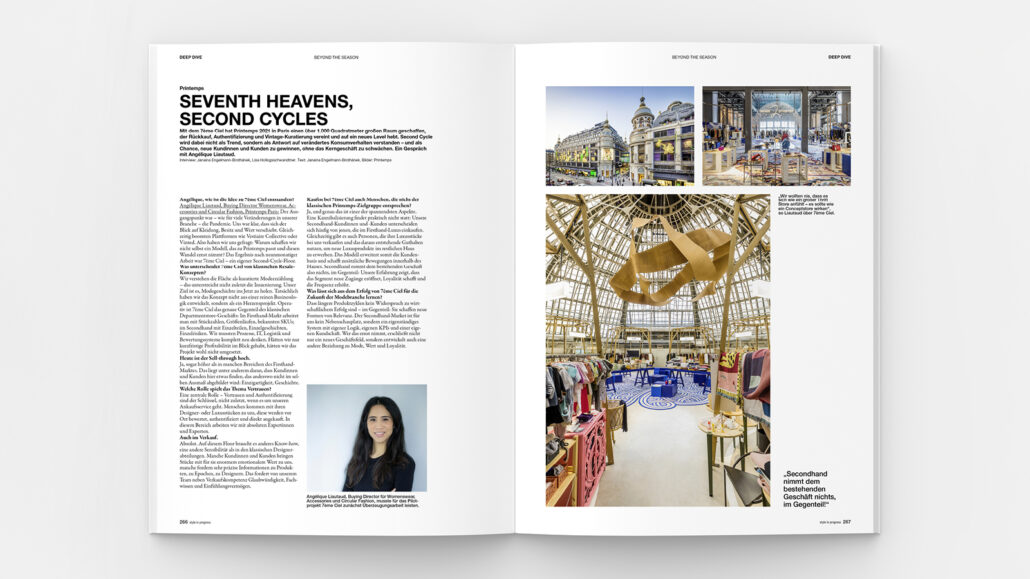
With 7ème Ciel, Printemps created a space in Paris in 2021 spanning over 1,000 square meters that combines buyback, authentication, and vintage curation, taking these services to a new level. Second Cycle is viewed not as a trend, but as a response to changing consumer behavior—and as an opportunity to attract new customers without undermining the core business. A conversation with Angélique Liautaud.
Interview: Janaina Engelmann-Brothánek, Lisa Hollogsschwandtner. Text: Janaina Engelmann-Brothánek. Photos: Printemps
Angélique, how did the idea for 7ème Ciel come about?
Angélique Liautaud, Buying Director for Women’s Wear, Accessories, and Circular Fashion at Printemps Paris: The starting point—as with many changes in our industry—was the pandemic. It was clear to us that attitudes toward clothing, ownership, and value were shifting. At the same time, platforms like Vestiaire Collective and Vinted were booming. So we asked ourselves: Why not create our own model that fits Printemps and takes this shift seriously? The result, after nine months of work, was 7ème Ciel—our very own Second-Cycle Floor.
What sets 7ème Ciel apart from traditional resale concepts?
We view the space as a curated fashion narrative—a fact underscored not least by the way it’s staged. Our goal is to bring fashion history into the present. In fact, we didn’t develop the concept based purely on business logic, but as a labor of love. Operationally, 7ème Ciel is the exact opposite of a traditional department store: in the new-clothing market, you work with quantities, size ranges, and familiar SKUs; in the secondhand market, you deal with individual items, individual stories, and individual risks. We had to completely rethink our processes, IT, logistics, and valuation systems. If we’d been focused solely on short-term profitability, we probably wouldn’t have gone through with the project.
Sell-through is high today.
Yes, even higher than in some segments of the new-goods market. One reason for this is that customers find something here that isn't represented to the same extent elsewhere: uniqueness and history.
What role does trust play?
A central role—trust and authentication are key, especially when it comes to our buying service. People bring their designer or luxury items to us, where they are appraised, authenticated, and purchased on the spot. In this area, we work with true experts.
Also available for sale.
Absolutely. This floor requires a different kind of expertise and a different sensibility than the traditional design departments. Some customers bring us pieces that hold tremendous emotional value for them, while others ask for very specific information about products, historical periods, and designers. This requires our team to possess not only sales skills but also credibility, expertise, and empathy.
Do people who don't fit the traditional Printemps target audience also shop at 7ème Ciel?
Yes, and that’s exactly one of the most exciting aspects. There’s virtually no cannibalization: Our pre-owned customers often differ from those who shop for new luxury goods. At the same time, there are also people who sell their luxury items to us and use the resulting credit to purchase new luxury products elsewhere in the store. This model thus expands the customer base and generates additional sales within the company. Pre-owned sales don’t take anything away from the existing business—on the contrary: Our experience shows that this segment opens up new avenues, builds loyalty, and increases foot traffic.
What lessons can be drawn from 7ème Ciel's success for the future of the fashion industry?
The fact that longer product cycles are not at odds with economic success—on the contrary: they create new forms of relevance. For us, the secondhand market is not a side issue, but a self-contained system with its own logic, its own KPIs, and its own customer base. Those who take this seriously not only tap into a new business segment, but also develop a different relationship with fashion, value, and loyalty.


