"Everyone wants to get into fashion, but fashion wants to get into food."
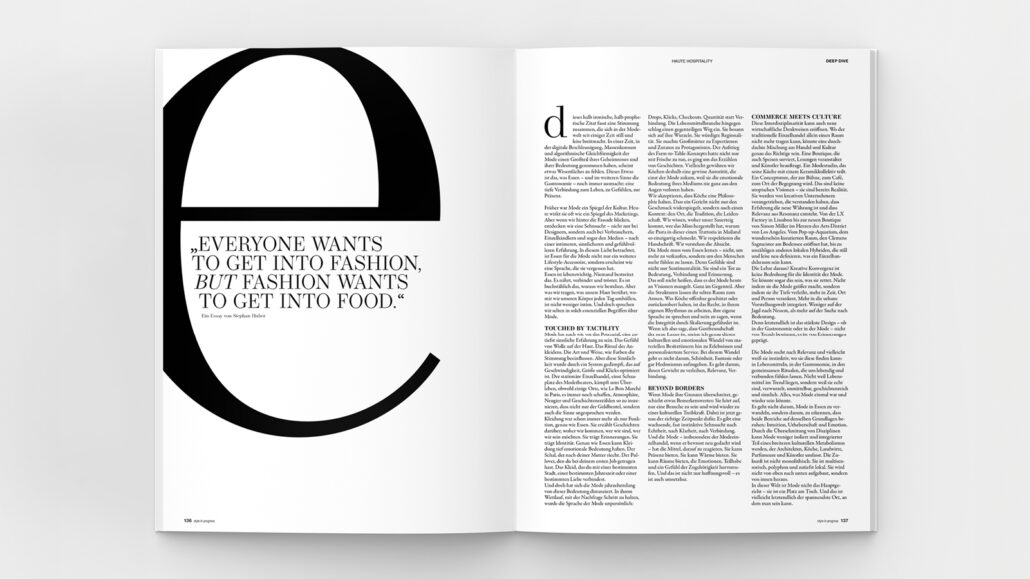
This half-ironic, half-prophetic quote sums up a mood that has been quietly spreading through the fashion world for some time now. At a time when digital acceleration, mass consumption and algorithmic uniformity have stripped fashion of much of its mystery and meaning, something essential seems to be missing. This something is what food - and gastronomy in a broader sense - is still all about: a deep connection to life, to feelings, to presence.
Fashion used to be a mirror of culture. Today, it often seems like a mirror of marketing. But if we look behind the façade, we discover a yearning - not only among designers, but also among consumers, retailers and even the media - for a more intimate, sensual and emotive experience. Seen in this light, food is not just another lifestyle accessory for fashion, but seems like a language it has forgotten.
Food is vital. Nobody denies that. It nourishes, connects and comforts. It is literally what we are made of. But what we wear, what touches our skin, what we wrap our bodies in every day, is no less intimate. And yet we rarely talk about fashion in such essential terms.
Touched by tactility
Fashion still has the potential to be a deeply sensual experience. The feel of wool on the skin. The ritual of dressing. The way colors affect mood. But this sensuality has been muted by a system optimized for speed, size and clicks. Brick-and-mortar retail, once the arena of fashion theater, is struggling to survive, although some places, like Le Bon Marché in Paris, still manage to stage atmosphere, curiosity and storytelling in a way that appeals not only to the wallet but also to the senses.
Clothing has always been more than just a function, just like food. It tells stories about where we come from, who we are and who we want to be. It carries memories. It carries identity. Just like food, clothes can have deep emotional meaning. The scarf that smells like your mother. The sweater you wore to your first job. The dress you associate with a certain city, a certain season or a certain love.
And yet fashion has distanced itself from this meaning for decades. In its race to keep up with demand, the language of fashion became impersonal: drops, clicks, checkouts. Quantity instead of connection. The food industry, on the other hand, took the opposite approach. It returned to its roots. It honored regionality. It turned grandmothers into experts and ingredients into protagonists. The rise of the farm-to-table concept wasn't just about freshness, it was about storytelling. Perhaps this is why we grant chefs a certain authority that fashion once had, because they have never completely lost sight of the emotional significance of their medium.
We accept that chefs have a philosophy. That a dish not only reflects the taste, but also a context: the place, the tradition, the passion. We know where our sourdough comes from, who made the miso, why the pasta in this one trattoria in Milan tastes so unique. We respect the signature. We understand the intention.
Fashion needs to learn from food - not to sell more, but to make people feel more. Because feelings are not just sentimentality. They are a gateway to meaning, connection and memory.
This is not to say that fashion today lacks vision. Quite the opposite. But the structures rarely give it room to breathe. What chefs seem to have protected or reclaimed is the right to work at their own pace, speak their own language and say no when integrity is compromised by scaling.
So when I say that hospitality is the new luxury, I mean precisely this cultural and emotional shift from material possessions to experiences and personalized service. This shift is not about giving up beauty, fantasy or even hedonism. It's about giving them weight, relevance, connection.
Beyond Borders
When fashion transcends its boundaries, something remarkable happens: it ceases to be just an industry and becomes a cultural driving force again. And now is exactly the right time to do so. There is a growing, almost instinctive longing for authenticity, for clarity, for connection. And fashion - especially fashion retail, if it is consciously rethought - has the means to respond to this. It can offer presence. It can offer warmth. It can offer spaces that evoke emotions, participation and a sense of belonging. And that is not only hopeful - it is also feasible.
Commerce meets culture
This interdisciplinarity can also open up new economic ways of thinking. Where traditional retail alone can no longer support a space, a well thought-out mix of retail and culture could be just the thing. A boutique that also serves food, hosts readings and commissions artists. A fashion studio that shares its kitchen with a ceramics collective. A concept store that becomes a stage, a café, a meeting place.
These are not utopian visions - they are already a reality.
They are driven by creative entrepreneurs who understand that experience is the new currency and that relevance comes from resonance. From the LX Factory in Lisbon to Simon Miller's new boutique in the heart of Los Angeles' Arts District. From the pop-up Aquarium, the beautifully curated space opened by Clemens Sagmeister on Lake Constance, to countless other local hybrids that are quietly redefining what a retail space can be.
The lesson? Creative convergence is not a threat to fashion's identity. It could even be the thing that saves it. Not by making fashion bigger, but by giving it depth, anchoring it more in time, place and person, integrating it more into the urban imagination. Less on the hunt for novelty and more in search of meaning.
After all, the strongest design - whether in gastronomy or fashion - is not determined by trends, it is shaped by memories.
Fashion is looking for relevance and perhaps it instinctively knows where to find it: in food, in gastronomy, in the shared rituals that make us feel alive and connected. Not because food is trendy, but because it is real, rooted, immediate, rich in history and sensual. Everything that fashion once was and could be again.
It's not about turning fashion into food, but about recognizing that both areas are based on the same foundations: Intuition, authorship and emotion. By transcending disciplines, fashion can become less isolated and an integrated part of a broader cultural metabolism that includes architects, chefs, farmers, perfumers and artists. The future is not monolithic. It is multi-sensory, polyphonic and deeply local. It is not built from the top down, but from the inside out.
In this world, fashion is not the main course - it is a place at the table.
And that is perhaps ultimately the most exciting place to be.


