Essay
The Economics of Trust
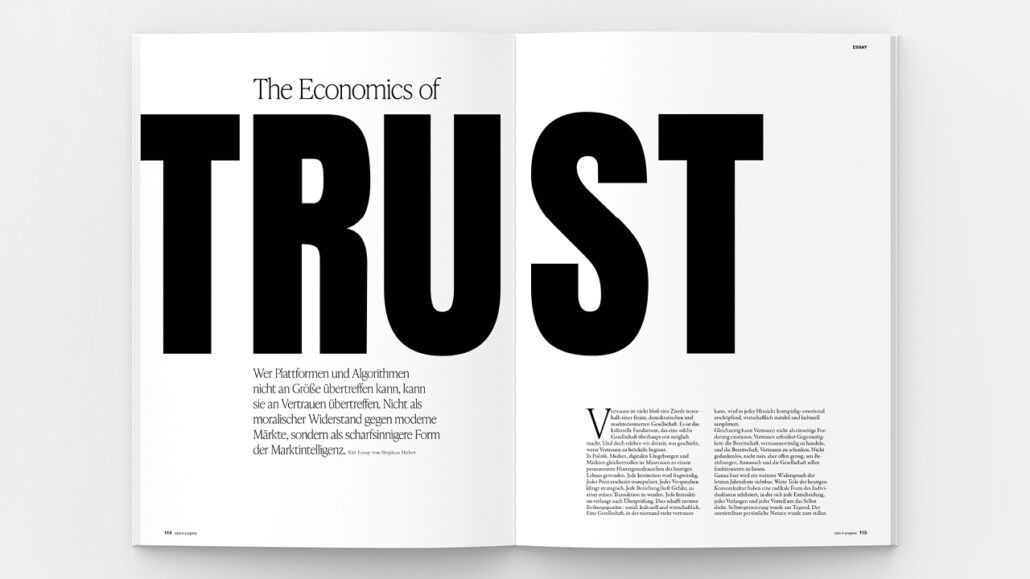
Those who cannot outgrow platforms and algorithms can outgrow them in terms of trust. Not as a moral resistance to modern markets, but as a more astute form of market intelligence.
An essay by Stephan Huber
Trust is not merely a nice-to-have in a free, democratic, and market-oriented society. It is the cultural foundation that makes such a society possible in the first place. And yet we are currently witnessing what happens when trust begins to crumble.
In politics, the media, digital environments, and markets alike, mistrust has become a constant background noise in modern life. Every institution is called into question. Every price seems manipulated. Every promise sounds strategic. Every relationship runs the risk of becoming a mere transaction. Every interaction demands scrutiny. This creates enormous points of friction: social, cultural, and economic. A society in which no one can trust anyone anymore becomes costly in every respect: emotionally exhausting, economically unstable, and culturally fragmented.
At the same time, trust cannot exist as a one-sided demand. Trust requires reciprocity: the willingness to act in a trustworthy manner and the willingness to place trust in others. Not thoughtlessly, not naively, but with enough openness to allow relationships, exchange, and society itself to function.
This is precisely where another contradiction of recent decades becomes apparent. Large parts of today’s consumer culture have celebrated a radical form of individualism in which every decision, every desire, and every advantage revolves around the self. Self-improvement has become a virtue. Immediate personal gain has become the unspoken organizing principle behind entire business models. Yet markets, just like democracies, cannot function sustainably on the basis of self-interest alone. A society built exclusively around the mantra “me first” undermines precisely the conditions that make trust possible in the first place.
This is of critical importance for industries that are not based on basic necessities, but rather on desire, experience, emotion, culture, and human connection—including the fashion industry. For as soon as trust disappears, these industries lose far more than just revenue. They lose emotional resonance and, ultimately, the very conditions that make desirability possible in the first place.
This is where Realness comes in. It’s a competitive strategy for those who can’t win through size, speed, platform power, or algorithmic dominance, but rather through expertise, trust, judgment, presence, and relationships. Realness is not a moral counter-movement to platform capitalism. It is a strategic response to a market environment in which trust, guidance, and human judgment have once again become economically decisive. Those who cannot outdo platforms and algorithms in size can outdo them in trust.
MORE THAN JUST A GOOD ALTERNATIVE
Moral debates rarely change consumer behavior. Better business models do. Realness doesn’t require anyone to be better. It offers a way to act more intelligently. No one builds a viable business model on constant self-sacrifice. And no one saves a market by confusing profit margins with guilt. So it starts with the sober realization that not every player in the market can win the same game. In a platform-driven economy, size wins the game of size. For independent retailers, independent brands, specialty agencies, artisans, and local businesses, trying to compete under these conditions isn’t brave. It’s foolish.
They won't be faster than the fastest system. They won't be cheaper than the cheapest system. They won't outperform other platforms in terms of range, data, or comfort.
And they don't have to.
Realness isn't the kinder option; it's the smarter one—not moral superiority, but market intelligence. Realness begins where algorithms stop understanding people.
WHERE PLATFORMS CAN'T REACH
Platform economies are designed around transactions. Amazon has perfected the seamless shopping experience. Temu and Shein have industrialized accelerated consumption. AI shopping agents will take this logic even further: predictive recommendations, automated selection, instant purchases. For many categories, this is highly efficient. Hardly anyone romanticizes the idea of ordering printer paper. In purely functional categories, reducing friction is often a genuine improvement. Not every purchase is a logistical problem waiting to be solved. A platform can distribute products on a massive scale; it can predict behavior; it can optimize recommendation loops. But there are still things it struggles to deliver convincingly: judgment, for example. An algorithm can tell someone what resembles their past purchases. An experienced stylist, a bookseller, a wine merchant, or a gallery owner can say what deserves attention and why. That’s not the same thing.
The human touch fosters a sense of trust that cannot be replicated digitally. A conversation in a store, a recommendation made with conviction, the atmosphere of a room, the feel of a garment, the memories associated with a place, the subtle sense of security that comes from expertise—these experiences have a different impact than transactional convenience.
This is one reason why physical spaces are regaining importance. They provide context. And context creates value. The same item that was purchased anonymously through endless scrolling takes on a different meaning when it is linked to a conversation, expert knowledge, a memory, or a physical experience.
Fashion cannot survive as a mere transaction. It requires context, interpretation, physical experience, and cultural significance surrounding the product itself. As soon as fashion is reduced to constant novelty and accelerated consumption, it undermines its own value. This logic did not stop at fast fashion. The luxury sector has adopted it as well. People don’t just remember what they bought. They remember how they felt when they bought it.
THE RETAILER AS A SOURCE OF TRUST
For a long time, the prevailing narrative was that independent retail was becoming obsolete. style in progress was never convinced by this. Not because we’re nostalgic romantics, but because we’ve spent enough time with real people. Platforms would replace expert knowledge with algorithms. Endless product ranges would replace curation. Convenience would replace conversation. Physical stores would gradually dissolve into logistics hubs, wrapped in lifestyle branding. It sounded convincing, and in certain areas, it even worked. But this diagnosis missed something fundamental. This is exactly where independent businesses are regaining their strength. The best were never just sellers of products. They were interpreters of complexity who built trust through judgment and expertise. Not by offering everything, but by knowing what actually deserved to be there. Selection is not a limitation; it is a responsibility.
TRUST BOTH IN FRONT OF AND BEHIND THE COUNTER
Trust must not end at the point of contact with customers. It must extend across the entire relationship chain that shapes a product long before it goes on sale. This is precisely where large parts of the fashion industry have undermined themselves. For years, enormous energy was poured into storytelling for consumers, while behind the scenes, mistrust quietly spread. The result is a market driven by uncertainty, even as it continues to speak the language of aspiration. For years, the industry has confused volume with strength. This has led to surpluses, dependencies, price erosion, and constant instability. Distrust is costly. It destabilizes pricing, weakens long-term thinking, and forces companies to constantly react rather than act out of conviction.
- Inflated pricing structures
- Artificial discount systems
- Overproduction Disguised as Optimism
- Panic buying
- Permanent risk transfer
What would a functioning market require? Relationships that can create stability, rather than constant uncertainty. Because trust changes market behavior: retailers source goods differently, suppliers produce differently, and customers make different decisions. Stable relationships lead to better decisions. And better decisions lead to stronger markets. This is not idealism. It is the logic of the economy of trust.
THE CITY AS EVIDENCE
For decades, retail has been increasingly reduced to a matter of efficiency: faster delivery, constant availability, seamless convenience. Urban retailers were told they had to compete by becoming smaller versions of logistics systems. That was a catastrophic misunderstanding. A city cannot survive simply as a collection of delivery addresses. Cities must create places that people actively want to experience. Because desire does not arise in isolation. People rarely want things in a vacuum. Desire is shaped by atmosphere, interaction, memory, discovery, and physical presence. Consumption often arises quite naturally from environments where people truly feel at home. That is why brick-and-mortar retail continues to play a role, especially in industries based on emotion, identity, and aesthetics. Not despite digital culture, but precisely because of it. After years of mediated consumption and constant digital acceleration, many people are increasingly seeking experiences that feel tangible and real—not simulated participation, but actual participation. Realness understands that retail is not just about moving products efficiently. It is about creating places where people can still enjoy being human.
THE FUTURE IS WIDE OPEN
What happens when trust once again becomes the foundation of economic life, rather than just a marketing slogan? Markets change. Companies source goods with greater conviction and manufacture with greater precision. Stable margins regain their importance. Long-term relationships once again become competitive advantages. Expertise, reliability, and a sense of responsibility regain their economic significance. Cities are changing too: more spaces that people actually want to enter, more independent businesses characterized by knowledge, presence, and character, streets defined not just by transactions but by encounters, culture, and participation. Consumption is changing—less driven by manipulation and constant stimulation, more connected to experience, quality, memory, and human judgment.
After all, society changes along with it. For an economy based on trust fosters a community rather than isolated consumers, participation rather than constant exploitation, responsibility rather than pure self-interest, and trust rather than mistrust. This is not a utopia. It is economic logic. A realistic path for businesses, retailers, brands, cultural spaces, and local economies that are capable of understanding where long-term value is actually created.
Realness isn't about turning your back on the future. It's the smartest way to move toward it.


