25 Jahre Komet und Helden
Offense wins championships!
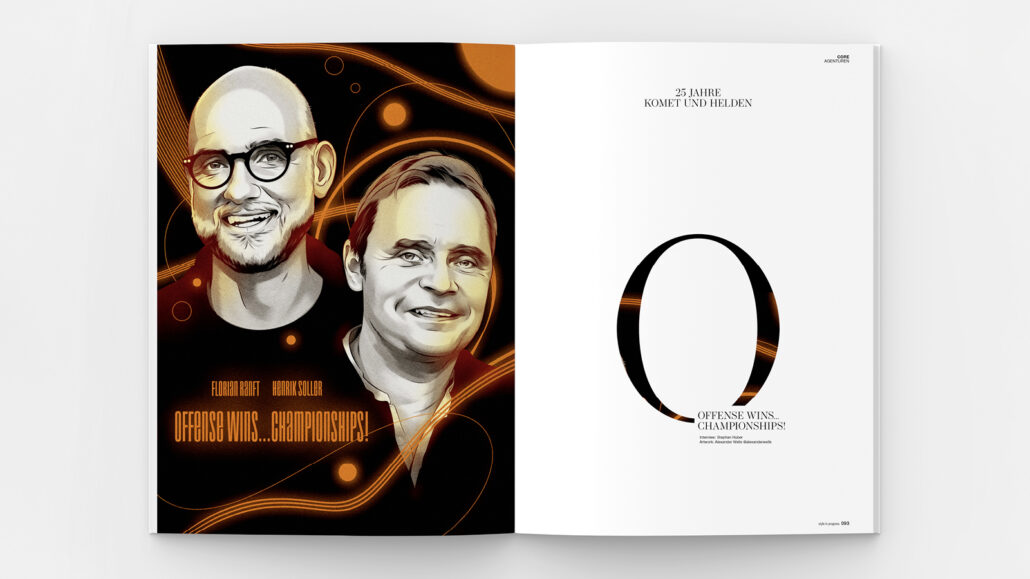
Interview: Stephan Huber. Artwork: Alexander Wells @alexanderwells
It's been a while since you throwing Bikkemberg soccer balls into the crowd from the exhibition booth in Berlin. When you look back on this quarter of a century, what comes to mind first? Pride, amazement, gratitude?
Henrik Soller, founder and owner of Komet und Helden: Detlef Igel kicked the soccer balls into the crowd back then. I just handed him the balls, but he definitely had the stronger kick.
I have to correct you there. I remember very well how seriously you took that task. You actually threw the balls halfway across the cable factory hall.
Florian Ranft, founder and owner of Komet und Helden: That was so long ago. And yet it's still so present. The response was enormous. It was crazy.
Henrik Soller: Dirk Bikkembergs was the first to recognize the potential that soccer stars—and sports stars in general—have for fashion. And we were there when he staged soccer stars as rock stars and brought sports marketing into fashion. We were with him at Bread & Butter. We were there when he collaborated with Umbro...
Florian Ranft: His shows were legendary. One of them actually took place at San Siro – unbelievable.
Now we are in the midst of the magic of the beginning. There are many legends surrounding the launch of Comet and Heroes. So, what really happened?
Henrik Soller: We actually knew each other before we started working in fashion. My parents had a small sports and fashion store. Florian's parents had a larger store on Lake Tegernsee and later a jet set store. I was the skier, Florian was more of a snowboarder. Later, I started working at Jet Set in St. Moritz—and suddenly Florian and his parents were standing in the showroom. Our paths kept crossing.
Florian Ranft: Then we met up again at Norbert Klauser's place. And that's where we made the decision: we want to do this together ourselves.
Isn't there this incredible story about the visit to the warehouse?
Henrik Soller: Back then, we had a white Mercedes V-Class bus. That sounds better than it was. In reality, the thing was—how should I put it—aesthetically challenging. The seats were light gray with a yellowish mushroom pattern. Completely bizarre, but still a great car.
Florian Ranft: Yes, visually the car was a disaster, but it was extremely reliable. And it was our first company car. We drove over 300,000 kilometers in it in a few years.
Henrik Soller: We were on our way from Düsseldorf to Munich—the order days were over—when we received the news that Hammond, the licensee of Bikkembergs Jeans, was filing for bankruptcy. And that meant we would lose our commissions for three seasons. For us as young entrepreneurs at the time, it was a disaster.
Florian Ranft: We sat in the car for two hours and hardly said a word. We thought, "That's it. We're broke." We talked specifically about dissolving everything and getting back in line.
Henrik Soller: And then Florian turned on the radio—and there was the news about September 11. Two planes had flown into the Twin Towers. We just looked at each other and said, "Okay. Things could always get worse." That was the moment when it became clear that giving up was not an option.
Florian Ranft: And then came this, let's call it "almost legal" idea.
Henrik Soller: We had a good relationship with Luigi, the warehouse manager at Hammond. He called us and said, "Guys, I found a door that isn't sealed." So it was open. It may not have been entirely legal, but after 25 years, the statute of limitations has probably expired, right? (laughs)
Florian Ranft: At least, I hope so. Anyway, Henrik was on vacation—Mauritius. Of course, Mauritius.
Henrik Soller: What was I supposed to do? My wife was still flying for Condor at the time, so I couldn't very well cancel the vacation. (laughs)
Florian Ranft: So I drove to Perugia on my own, loaded the van to the roof, drove home, picked up my brother, and we drove back down again. Two full loads. In the end, we had about 3,500 jeans.
Henrik Soller: And then we sold them—the goods were there, they owed us the money. Without this action, Komet and Helden would not exist today.
I still find the name unusual.
Florian Ranft: "Ranft Soller Fashion Agency" was simply not an option. So we started brainstorming.
"Henrik and Flo" would have been fine too.
Henrik Soller: I actually wanted to call it something completely different. Something like "Enterprise Holding" or something like that. But Florian just said, "Are you crazy?"
Florian Ranft: We needed a name that we could also use for something else if it didn't work out in fashion.
Henrik Soller: Exactly. So something that could also work as "Komet und Helden Records." Or as "Kometenbräu," "Komet und Heldenbräu"—or as a fan club in the south stand: instead of Schickeria, then "Komet und Helden." It had to be open to all possibilities.
Florian Ranft: The name just happened, really.
Henrik Soller: Ultimately, it was a combination of words from the Argonaut legend. At some point, comets appeared, and a few paragraphs later, heroes. And at some point, we said: That's it.
Today it's a brand. How steep was the learning curve at the beginning?
Florian Ranft: I remember a hard lesson! It was our first time in Düsseldorf, and we had rented a beautiful photo studio for five days. We drove up with all our merchandise in a delivery van, spent the whole night setting up, and got the showroom ready—everything was perfect. We really wanted to do it right and set up a huge Italian buffet. With a wheel of Parmesan, the finest Parma ham... the whole shebang. And then we had three customers in the showroom in five days, maybe four. Even though we had sent out a really nice invitation.
Henrik Soller: The buffet was great—everything tasted fantastic.
Florian Ranft: We thought people knew us, so they would come. But at first, no one came. We drove back from Düsseldorf feeling pretty depressed.
Henrik Soller: Our mistake was that we didn't set fixed appointments, but trusted that people would come by. They didn't. And that hasn't changed to this day, by the way. This lack of commitment already existed when there were no online retailers. It has always been an issue.
While we're on the subject of people, would you say that over the past 25 years, people's business has actually been the constant factor?
Henrik Soller: There is no single key, but people's business is undoubtedly one of the most important. If it weren't, the fashion industry in its current form would no longer be necessary. Seriously, these days you don't have to buy anything at full price—you can get discounts everywhere. And yet people still go to their local retailer. To the one who knows them. Who recommends something to them, who makes them feel good.
Florian Ranft: That applies just as much to our level. We have relationships that have lasted for over 20 years. We have been working with Blauer for 23 years. That's incredible.
And that's what determines success in the end, isn't it?
Florian Ranft: Absolutely. But that doesn't happen in the meeting room. It happens over dinner after the trade fair. In conversations that actually only begin after work.
Henrik Soller: And it's not a sure-fire success. It takes work, it takes care, and above all, it takes presence. If you don't nurture relationships, they die. But if you nurture them, they survive even difficult times. Incidentally, I find it interesting that we get on much better with companies that are owner-managed, not listed on the stock exchange, not private equity. Take Superdry, for example: as long as it was run by the three founders—James Holder, Theo Karpathios, and Julian Dunkerton—it was pure people's business. Then came the managers, the stock market, the numbers. And the soul was gone.
Florian Ranft: And then, after years, Julian Dunkerton called again: "I'm back. Can we work together again?" We agreed immediately because we knew that now it would be a meeting of equals again.
Speaking of genuine encounters: Bread & Butter, and Karl-Heinz Müller, must have had a profound impact on you.
Florian Ranft: It was definitely a highlight when Karl-Heinz came into our showroom, completely absorbed in the idea of organizing a trade fair. We went out, ate pea soup at the market, and he explained his vision to us. Our first thought was, "He's completely crazy." And then it turned into Bread & Butter.
Henrik Soller: And we were there from the very beginning, with three brands. It was the birth of Bread & Butter, and what it became was truly extraordinary. A universe of its own, a spirit that didn't exist before.
Florian Ranft: That period had a huge impact on us. I think we once had twelve brands represented in the Lock Hall alone. Twelve! That shows how important this trade fair was for us.
Henrik Soller: And it wasn't just important for business, it was simply an incredibly good time. A time when energy, inspiration, and community were palpable. Bread & Butter shaped the entire industry and had a particularly significant impact on us personally.
25 years of Komet and Helden also means that you two have come a long way together.
Florian Ranft: That's almost half a lifetime.
Henrik Soller: Yes—and it works. Because we are different, and therefore complement each other. If Florian had my negative traits—and I had his—we would have clashed long ago.
Florian Ranft: We never discussed who would do what. It just always worked out that way. Everyone has their role—even today.
Henrik Soller: And what was important was that we always had our own circle of friends. We spend so much time together during the day. If we had also hung out together in the evenings, it would have caused friction at some point. But there was one big change: we now have single rooms.
Florian Ranft: Because you snore. Finally, you admit it.
Henrik Soller: I've been snoring the same way for 25 years. You've just become more sensitive.
Florian Ranft: We shared rooms for 20 years, and now suddenly we don't. It's a completely new situation. (laughs)
Today, you are a company with many employees. People who have joined you, people who have stayed with you for a long time. For many in the industry, human resources is one of the most difficult issues. How do you experience this?
Henrik Soller: Personnel has always been an issue. Even for my parents, and even for my grandmother, who had a butcher shop in Berlin. Finding people who stay, who fit in, who go along with things—that was never easy. And you can't please everyone. It just doesn't work.
Florian Ranft: The narrative that "everything was better in the past" is not true. Twenty years ago, it was just as difficult as it is today. Every company, every industry is looking for good people. The restaurant industry, retail, manufacturing—everyone is talking about it. It is one of the fundamental issues shaping entrepreneurship, not a trend.
Henrik Soller: And many underestimate how complex human resources are today. Many brands and retailers have grown extremely rapidly in recent years without their internal structures growing along with them. This leads to overload—not because people are bad, but because the system is not stable enough.
Florian Ranft: We have people who have been with us for many, many years. In sales, we have employees who have been working with us for over 20 years. This shows that loyalty still exists, but you have to earn it. With trust, with authenticity, with clarity.
Henrik Soller: We're definitely not the easiest bosses to work for. (laughs) But we're honest. And we're there for our people. I think that's the key thing: presence. If you don't nurture relationships, they die. That applies to customers, but also to employees.
Is fashion still attractive to young people?
Florian Ranft: Yes, it is. But the approach has changed completely. In the past, many people wanted to stay with one company for decades. Today, many want to have as many positions as possible on their resume after ten years. This is not a sign of a lack of loyalty, but simply a different view of career and development.
What do you think makes the industry attractive to young people?
Henrik Soller: Fashion is alive. You are constantly working with new products, new collections, new ideas. Something new comes along two to four times a year. That keeps the job fresh—which is hugely attractive to many young people. And you meet like-minded people. That's a factor that many people underestimate. Connections are formed through enthusiasm, which isn't the case in every industry.
Florian Ranft: That's right! Our employees also do things together in their private lives; they travel together and have formed friendships that go far beyond the job. That's not something to be taken for granted. This job thrives on encounters. You have to be cut out for it: for the traveling, the people, the energy, the speed. If you like that, it's a dream job.
Henrik Soller: All of this shows that the industry is attractive. But young people today need guidance. They need clear and fair leadership. If you overwhelm them or simply put pressure on them, they will leave. If you give them support, they will stay and flourish.
Over the years, we have often and intensively discussed the role and importance of sales agencies. You know my conviction: this importance will even increase again. Prove me wrong.
Henrik Soller: We're happy to take that. (laughs) But I don't think the agency will regain the importance it had 20 or 25 years ago. It will take on a different kind of importance.
Florian Ranft: The market has changed completely. It's no longer just about distribution, about getting goods from A to B. Today, brands need partners who can read the market, who can communicate, translate, and filter.
Henrik Soller: Agencies used to be bottlenecks. Everyone had to go through them. Today, we are navigators. We are often the only ones who can still give honest feedback beyond corporate structures or political constraints.
So, a hub where the market, product, culture, and experience converge?
Henrik Soller: Yes, exactly. A platform. Almost like a small trade fair—only more flexible. Since Bread & Butter disappeared, no one has taken on this role. And more and more agencies are filling this gap because they are close to the people, close to the brands, and close to the retail sector.
Florian Ranft: And because they need to create clarity. In the past, a brand had five years to prove itself. Today, you have two seasons. You have to be able to say early on, "This is going to work" or "This isn't going to work." That's also a responsibility.
Henrik Soller: And that brings us back to people's business. It only works through proximity, trust, experience, and genuine conversations. So yes, agencies are becoming more important because the industry is becoming increasingly complex.
Another well-known theory of mine, and one that has a lot to do with your business, is that brick-and-mortar retail is regaining massive importance. And I've now been confirmed in this view by KPMG and others. What's your take on this?
Florian Ranft: I see it the same way. People are shopping more consciously today. They want someone who knows them, advises them, and gives them guidance. That's a strong signal for retailers.
Henrik Soller: Brick-and-mortar retail is making a comeback, but it's not being given a fair chance to really make that comeback happen. And that's a problem that extends far beyond our industry.
Because the framework conditions are not right?
Henrik Soller: Exactly. It's not about consumer demand—that's already there. It's about three structural barriers: First, global competition that doesn't play by the same rules. Rules of the game, price points, tax structures—everything is shifted. A local retailer can't compensate for that. Second, store opening hours that no longer fit in with modern realities. That's a real obstacle to location. And third, the rental situation. We've run stores ourselves. We know what we're talking about. Many landlords show no flexibility whatsoever. "Pay or move out" is a business model for some.
Florian Ranft: It's paradoxical: everyone wants vibrant city centers. Everyone talks about encounters, culture, diversity. But when it comes to concrete support, often nothing happens.
Henrik Soller: For me, it's clear: brick-and-mortar retail is making a comeback, but it's not happening on its own. It needs fair conditions, it needs partners: landlords, politicians, location developers.
In other words, consumers want it, but the structure is holding it back?
Henrik Soller: Exactly. You don't really need to buy anything at regular prices anymore. You can get everything cheaper somewhere else. And yet people still go to their local retailers because they get something there that no algorithm can replace: trust, personality, attitude. That's the opportunity for retailers. But if this opportunity is constantly being thwarted by structural problems, then it's not just retailers that suffer, but the entire industry.
Despite all the challenges, I feel that you are particularly alert and motivated right now.
Florian Ranft: I know you've told me before that you feel that way about us, and somehow I feel the same way. I can't really explain why that is. We've been traveling a lot over the last few months and have seen so many things. We've been super active. And yes, that's challenging. But that's also what makes it exciting. If we weren't curious anymore, it would be bad.
Henrik Soller: You can't win a game by playing defensively. You have to score goals. And we've always maintained this offensive mindset.
So the energy comes from desire?
Florian Ranft: Yes, of course. Definitely. It's really fun again.
Henrik Soller: And there are also visions for the future. For me, for example, that's my eldest son, who has been in the business for three years now and is taking on more and more responsibility. I know exactly why I do what I do. That automatically makes you happy. There are moments in life that simply motivate you.
Florian Ranft: And then there's the opposite: moments that feel difficult. That's exactly when it's important to have someone by your side. I don't think 25 years would have been possible without this teamwork.
Henrik Soller: Absolutely. That's the beauty of doing it together. Ultimately, doors always open again. When we lost Woolrich back then, or AG more recently, it was tough, of course. And then you get a call from Julian Dunkerton and suddenly you're back in the game, motivated again. A lot is happening right now. With Blauer, we have the best figures in 23 years. BasicNet brands such as Sebago, Superga, and K-Way are also super successful—it's just a perfect fit. And we have a Scandinavian label in our portfolio for the first time. There's a lot of momentum building right now.
So ultimately, the secret is: you keep moving?
Henrik Soller: Yes. Proactivity, curiosity, enthusiasm. Always. And people you enjoy working with—both internally and externally. Ultimately, it's that simple.


